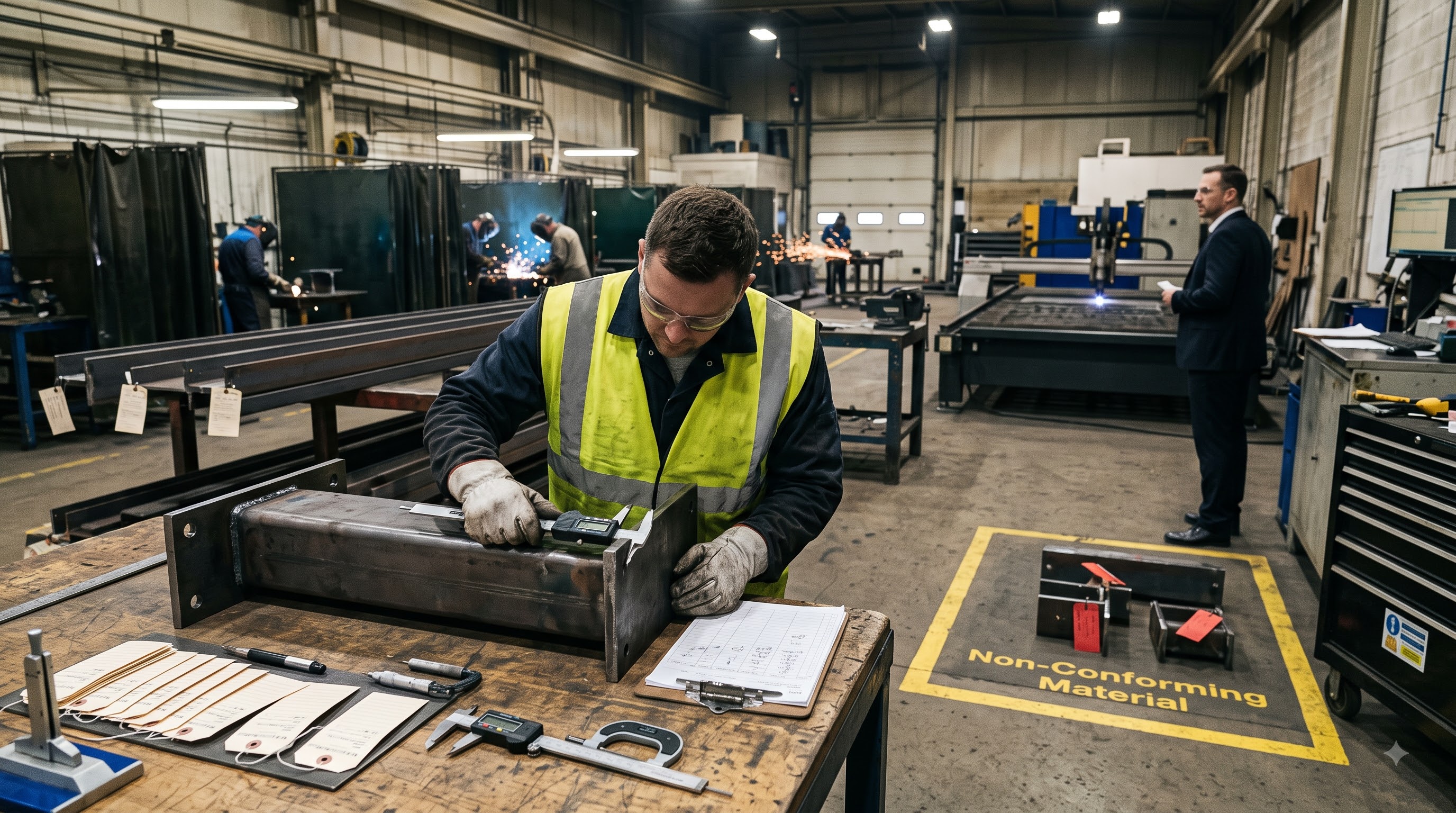
ISO Certification for Metal Fabrication: Requirements, Audits and Common Gaps
The certification auditor asks to see material traceability for a structural weld completed three weeks ago. You have the mill certificate. You have the WPS. But the heat number photographed at goods-in doesn't match the one stamped on the finished assembly. The trail is broken. What should have been a routine surveillance audit is now a major non-conformance.
This scenario plays out in fabrication shops across the UK every year. ISO certification for metal fabrication isn't just about passing an audit, it's about proving you can control material traceability, manage welder qualifications, and demonstrate weld integrity before a client audit or product failure forces you to.
What ISO Certification Means for Metal Fabrication

ISO certification for metal fabrication is third-party verification that your quality, safety, or environmental management systems meet international standards. For fabrication businesses, three standards matter most:
ISO 9001 (quality management) is the most common and often client-required. It controls how you manage material traceability, welding procedures, welder qualifications, and non-conformances.
ISO 45001 (health and safety) is critical for operations involving welding fumes, heavy machinery, and manual handling. It structures how you protect workers from burns, respiratory hazards, and lifting injuries.
ISO 14001 (environmental management) applies if you use hazardous chemicals, generate metal waste, or operate plating or surface treatment lines. It covers emissions, effluent, REACH compliance, and waste management.
Many fabricators also pursue sector-specific standards like EN 1090 (structural steel), AS9100 (aerospace), or ISO 3834 (welding quality) alongside their core ISO certification.
Fabrication businesses pursue ISO certification for three main reasons: client or tender requirements (especially in automotive, aerospace, and construction), competitive differentiation, and operational risk reduction. When implemented properly, ISO structures how you control processes before problems reach the customer.
Core Requirements: What ISO Actually Demands from Fabricators
Here's what each standard requires in a fabrication environment:
ISO 9001 for Metal Fabrication

ISO 9001 controls the quality processes that matter most in fabrication: material traceability, welding control, inspection, and non-conformance management.
Material traceability (Clause 8.5.2) requires you to track heat numbers, cast numbers, and mill certificates from receipt through cutting, welding, and final assembly. The most common failure is heat numbers getting lost between operations, the number photographed at goods-in doesn't match the stamped component, and you can't prove material origin.
Welding control (Clause 8.5.1) means Welding Procedure Specifications (WPS) and Welding Procedure Qualification Records (WPQR) must be documented and followed. Welder qualifications, ISO 9606, EN 287, or AWS, must be current and tracked. The typical gap: welder continuity lapses, expired certificates are discovered only during a client audit, and work performed by unqualified welders becomes a major non-conformance.
Inspection and testing (Clause 8.6) covers Non-Destructive Testing (NDT), ultrasonic, magnetic particle inspection, X-ray, performed, recorded, and traceable to specific welds. Measuring equipment must be calibrated. The common problem: NDT reports are scattered across job folders with no link between weld defect trends and corrective action.
Non-conformance management (Clause 10.2) requires weld repairs, dimensional errors, and surface defects to be logged and root-caused. Yet the same NCRs often appear audit after audit because immediate fixes are applied without investigating why the problem keeps recurring.
ISO 9001 doesn't just ask "do you have procedures?" It asks "can you prove this weld was done by a qualified welder, using an approved WPS, with material you can trace back to the original mill certificate?" Most fabrication shops can't answer that in real time.
ISO 45001 for Metal Fabrication

ISO 45001 controls the high-risk hazards inherent to fabrication: welding fumes, heavy machinery, manual handling, and confined spaces.
Welding fume and respiratory protection (Clause 8.1.2) requires Local Exhaust Ventilation (LEV) systems to be tested, typically every 14 months in the UK. Respiratory Protective Equipment (RPE) must be fit-tested and maintained. Health surveillance (lung function tests, audiometry for noise exposure) must be current. The gap that appears repeatedly: LEV test certificates have expired, discovered only during an HSE inspection or external audit.
Machine guarding and LOTO (Clause 8.1.2) covers Lockout/Tagout procedures for hydraulic presses, shears, and CNC equipment, plus guards on grinders and cutting tools. The common failure: LOTO isn't consistently applied, and near-miss incidents aren't investigated.
Lifting equipment safety (LOLER compliance under Clause 8.1.2) requires cranes, hoists, and lifting tackle to be inspected and certified every 6 or 12 months. The typical problem: LOLER registers are incomplete, and expired certificates are found during audit.
In fabrication, ISO 45001 means auditing the shop floor, checking LEV velocity with an anemometer, verifying LOTO application on live equipment, inspecting lifting tackle, not just reviewing safety policies in an office.
ISO 14001 for Metal Fabrication

ISO 14001 controls the environmental impacts of fabrication: chemical use, waste, emissions, and effluent.
Chemical and waste management (Clause 8.1) requires hazardous waste, cutting fluids, oils, solvents, plating chemicals, to be stored and disposed of legally. If you operate electroplating or chromate conversion coating, you must comply with REACH regulations, tracking hexavalent chromium (CrVI) authorisations and sunset dates. Spill containment (bunding for oil and chemical storage) must be in place. The common gap: REACH chemical registers are out of date, and sunset dates are missed.
Effluent and emissions control (Clause 8.1) applies if you run plating, anodising, or pickling operations. pH monitoring for effluent, VOC emissions from surface treatment, and compliance with environmental permits and trade effluent consents are required. The failure point: monitoring isn't done as frequently as the permit requires, and breaches are discovered during Environment Agency inspections.
Energy and scrap management (Clauses 8.1 and 9.1) covers metal scrap segregation and tracking (part of environmental aspects) and energy consumption monitoring, important given the high use from furnaces, plasma cutters, and welding equipment.
ISO 14001 in fabrication isn't just about recycling bins. It's about proving your plating effluent stays within permit limits and your REACH chemicals are legally authorised.
Common Gaps in Fabrication ISO Audits

Most fabrication shops pass their certification audits. But passing and having real control are different things. These are the gaps that appear again and again in internal and surveillance audits.
Gap 1: Broken Material Traceability
Heat numbers are recorded at goods-in but lost during cutting or forming. The final weld can't be traced back to the original mill certificate. This happens because traceability relies on manual records, heat stamps fade or get cut off, and there's no photo evidence at each stage. The impact: client rejects the product, leading to rework or scrap and a certification non-conformance.
Gap 2: Expired Welder Qualifications
Welder continuity lapses, ISO 9606 or EN 287 certificates expire, and nobody notices until an audit or client spot-check. There's no central tracking, it relies on individual welders or supervisors remembering dates. The result: work done by an unqualified welder, potential product recall, and a major non-conformance.
Gap 3: LEV Systems Not Tested on Schedule
Local Exhaust Ventilation test certificates expire, fume extraction isn't verified, and the lapse is discovered during an HSE inspection or external audit. LEV tests are scheduled manually with no automated reminder and become low priority until enforcement arrives. The outcome: prohibition notice from HSE, audit non-conformance, and welder health risk.
Gap 4: NDT Records Scattered, No Trend Analysis
Ultrasonic, MPI, and X-ray reports are filed per job with no visibility of repeat weld defects across projects or welders. NDT evidence is stored in job folders or emails, not centralised. High weld repair rates continue undetected, root causes are never addressed, and rework costs rise.
Gap 5: Repeat NCRs Never Root-Caused
The same non-conformances, dimensional errors, surface finish issues, weld spatter, appear audit after audit. NCRs are closed with an immediate fix, but there's no investigation into why the problem keeps happening. The result: no continual improvement, audits become tick-box exercises, and operational problems persist.
These gaps aren't caused by poor welders or lazy supervisors. They're caused by systems that rely on memory, manual tracking, and scattered evidence.
How to Close the Gaps

Closing these gaps requires five changes to how fabrication audits are managed:
1. Centralise audit evidence
Stop storing mill certificates in one folder, NDT reports in another, and welder certificates in a filing cabinet. Put traceability evidence, qualifications, and test certificates in one searchable system where auditors can find everything linked to a specific weld or job.
2. Automate expiry tracking
Flag welder certificate renewals, LEV test dates, LOLER inspections, and REACH sunset dates before they lapse, not after. Automated reminders mean expired qualifications and test certificates don't become audit non-conformances.
3. Link findings to actions
Every non-conformance needs an owner, a deadline, and a verification step. If weld defects keep appearing, root cause analysis should be mandatory, not optional. Follow the PDCA cycle: Plan the fix, Do the action, Check it worked, Act on lessons learnt.
4. Audit the floor, not just the files
Internal audits should include physical checks: photograph heat numbers on-site, verify LEV velocity with an anemometer, inspect lifting tackle, check welder continuity in real time. Auditing reality, not just records, is what finds problems before clients do.
5. Track trends across projects
If three jobs in a row show high weld repair rates with the same welder or WPS, that should trigger investigation. You can't see that pattern if audit findings are buried in separate reports.
How iAudit Global Helps
iAudit Global was built by ISO auditors who worked in fabrication environments. It centralises material traceability evidence, tracks welder and LEV expiry dates, links NDT reports to specific findings, and follows PDCA so corrective actions actually close.
Mobile checklists let you audit on the shop floor, photograph heat numbers, check LEV systems, verify LOTO application, with evidence attached directly to findings. Dashboards show trends across sites and projects, so repeat weld defects or NCRs become visible before they become systemic problems.
Your audit history stays with your organisation. We operate a zero-access policy, so your findings remain private.
Free ISO Programme Review (First 500 Companies Only)
We're offering an independent review of your current ISO audit programme to the first 500 fabrication and metal industry businesses that request it, completely free, with no obligation.
What you'll receive:
- Independent assessment of how your internal audits are structured, scheduled, and documented
- Gap identification across material traceability controls, welder qualification tracking, LEV and LOLER compliance, and NCR management
- Practical recommendations on where your audit programme can be strengthened to reduce repeat non-conformances and improve certification readiness
- Written review report delivered within 5–7 working days of our initial conversation
There's no sales pressure. We review your programme, highlight what's working and what isn't, and you decide whether you want to make changes.
This offer is limited to the first 500 requests. Once we reach that number, the free review programme closes.
Request your free ISO programme reviewISO certification for metal fabrication requires strict control over material traceability, welder qualifications, and safety compliance. ISO 9001 governs quality processes including heat number tracking, WPS/WPQR documentation, and NDT evidence. ISO 45001 covers welding fume control, LEV testing, LOTO procedures, and LOLER compliance. ISO 14001 manages hazardous waste, REACH chemicals, and effluent monitoring.
Common audit gaps include broken material traceability, expired welder certificates, lapsed LEV tests, scattered NDT records, and repeat non-conformances without root cause analysis. Close these gaps by centralising evidence, automating expiry tracking, linking findings to corrective actions, auditing on the shop floor, and tracking trends across projects.
iAudit Global helps fabrication businesses manage ISO 9001, 45001, and 14001 audits with mobile checklists, automated tracking, and PDCA-driven workflows. Try free for 14 days or request a free ISO programme review.